Thursday, July 15, 2010
Our time spent so far!
We’re halfway through the Union Summer Program and couldn’t be more pleased with what we’ve done so far. We worked at collecting the district zip codes of State Senate and Assembly members. It was more difficult than we expected but we prevailed, resulting in a feeling of gratification at the end of the three-day process. It included phone calls, faxes and tedious Internet searches but overall we were very proud of all our work. Sean, our site coordinator, made sure we were motivated and tried to help as much as possible in the process also. We went to Queens to meet with the IAMAW to learn about house calls. We had training where we learned how to speak to the workers who we would be trying to have join the union. The more workers are in a union, the stronger the union is that can then use their power to help protect workers and their rights. Unions are an important part of the structure of a workplace because it allows for workers to voice their opinions about issues without risking being fired. When we went on the house calls it was frustrating that some people no longer worked for the company or no longer lived at that address, however those that we had the opportunity to speak to were responsive. We’ve worked with Pathmark to help leaflet about the possible strike that might take place in Pathmark, Stop and Shop, and King Kullen We went to an informational picket with the American Postal Workers Union that supported the workers fighting to work on Saturdays. Less days worked means less days of pay and more layoffs that would result in overworking of the remaining postal workers. Our work with the Machinists continued over the next few weeks starting with a visit to the Delta shareholders meeting. While shareholders met inside to discuss the company, we and other Delta employees stood outside to distribute informational flyers on what the union hoped to accomplish. While we continued to leaflet for the Delta campaign outside the office, inside the office time was spent calling council members and asking them to sign letters of solidarity supporting the employees organizing campaign. This past week we saw the results of all our leafleting at a barbeque aimed at the JetBlue and Delta employees. Other work that we have done included a visit to the Carpenters union rapid response event where we listened to the unemployed voice their concerns. We also distributed information about how to speak with creditors and how certain organizations can help with health insurance support, amongst other information about immigration services, how to file for unemployment and a packet on how to cope with being unemployed while at the meeting. All in all our time has been spent experiencing the movement and learning from our experiences.

Friday, June 25, 2010
The past two weeks have been a great learning experience for all of us at the Union Summer Program in New York.
Last week we worked at collecting the district zip codes of State Senate and Assembly members. It was more difficult than we expected but we prevailed, resulting in a feeling of gratification at the end of the three-day process. It included phone calls, faxes and tedious Internet searches but overall we were very proud of all our work. Sean, our site coordinator, made sure we were motivated and tried to help as much as possible in the process also. We went to a rally that supported the municipal workers in New York City, which are being faced with the possibility of having cutbacks that would result in layoffs in all areas. These municipal workers include sanitation workers, nurses, teachers, and 911 operators among many others that help run and save this city everyday. We also went to a press conference where Kirstin Gillibrant, Carolyn Maloney, Margaret Chin and Anthony Weiner made speeches about the 9/11 firefighters and police officers that risked their lives to save the people in the World Trade Center after the massive attack that severely wounded our city. These men and women who have since then been sick due to the risks they faced entering those two buildings are being denied health coverage from the government. They vowed to work to have health bills passed for these workers by the nine year anniversary of the attack on New York City and to explain to others why this is an important issue that needs to be addressed.
This week we went to Queens to meet with the IAMAW to learn about house calls. We had training where we learned how to speak to the workers who we would be trying to have join the union. The more workers are in a union, the stronger the union is that can then use their power to help protect workers and their rights. Unions are an important part of the structure of a workplace because it allows for workers to voice their opinions about issues without risking being fired. It was a little frustrating that some people no longer worked for the company or no longer lived at that address, but it was a reality we had to face in order to learn about the process. Wednesday was a busy day where we went to another press conference, this time about Walmart trying to put a store in Brooklyn. People from all different unions, including the UFCW and RWDSU, came out to show their support to keep New York City free of Walmart’s business. Fighting such a large company is a difficult task and it was inspiring to know that there was so much support. We then went to Pathmark to help leaflet about the possible strike that might take place in Pathmark, Stop and Shop, and King Kullen. Negotiations over the workers wages and benefits have not been going well so the result has been the possibility of a strike starting Saturday June 26th. Finally we went to an informational picket with the American Postal Workers Union that supported the workers fighting to work on Saturdays. Less days worked means less days of pay and more layoffs that would result in overworking of the remaining postal workers. Thursday, there was training on Political Action Organizing, where we learned about the proper way to speak to someone in a debate in order to get your opinion across and how to work with political leaders to lobby the issues from your union. On Friday we leafleted in Nassau, Queens and Brooklyn about the Pathmark negotiations again. We met all types of people while doing it and found it encouraging that so many people were supportive of the cause. It felt good to know that others were for unions and were willing to do what was necessary to fight for their rights. As for next week, it sounds like it’s packed with just as many events and activities. This internship has been so rewarding already, it is only sure to get better.
Last week we worked at collecting the district zip codes of State Senate and Assembly members. It was more difficult than we expected but we prevailed, resulting in a feeling of gratification at the end of the three-day process. It included phone calls, faxes and tedious Internet searches but overall we were very proud of all our work. Sean, our site coordinator, made sure we were motivated and tried to help as much as possible in the process also. We went to a rally that supported the municipal workers in New York City, which are being faced with the possibility of having cutbacks that would result in layoffs in all areas. These municipal workers include sanitation workers, nurses, teachers, and 911 operators among many others that help run and save this city everyday. We also went to a press conference where Kirstin Gillibrant, Carolyn Maloney, Margaret Chin and Anthony Weiner made speeches about the 9/11 firefighters and police officers that risked their lives to save the people in the World Trade Center after the massive attack that severely wounded our city. These men and women who have since then been sick due to the risks they faced entering those two buildings are being denied health coverage from the government. They vowed to work to have health bills passed for these workers by the nine year anniversary of the attack on New York City and to explain to others why this is an important issue that needs to be addressed.
This week we went to Queens to meet with the IAMAW to learn about house calls. We had training where we learned how to speak to the workers who we would be trying to have join the union. The more workers are in a union, the stronger the union is that can then use their power to help protect workers and their rights. Unions are an important part of the structure of a workplace because it allows for workers to voice their opinions about issues without risking being fired. It was a little frustrating that some people no longer worked for the company or no longer lived at that address, but it was a reality we had to face in order to learn about the process. Wednesday was a busy day where we went to another press conference, this time about Walmart trying to put a store in Brooklyn. People from all different unions, including the UFCW and RWDSU, came out to show their support to keep New York City free of Walmart’s business. Fighting such a large company is a difficult task and it was inspiring to know that there was so much support. We then went to Pathmark to help leaflet about the possible strike that might take place in Pathmark, Stop and Shop, and King Kullen. Negotiations over the workers wages and benefits have not been going well so the result has been the possibility of a strike starting Saturday June 26th. Finally we went to an informational picket with the American Postal Workers Union that supported the workers fighting to work on Saturdays. Less days worked means less days of pay and more layoffs that would result in overworking of the remaining postal workers. Thursday, there was training on Political Action Organizing, where we learned about the proper way to speak to someone in a debate in order to get your opinion across and how to work with political leaders to lobby the issues from your union. On Friday we leafleted in Nassau, Queens and Brooklyn about the Pathmark negotiations again. We met all types of people while doing it and found it encouraging that so many people were supportive of the cause. It felt good to know that others were for unions and were willing to do what was necessary to fight for their rights. As for next week, it sounds like it’s packed with just as many events and activities. This internship has been so rewarding already, it is only sure to get better.
Friday, June 18, 2010
Union Summer Week 1
Today has been eventful and the past week has been successful. We have been working more on the State Senate and Assembly member district zip codes which has shown to be a little more difficult than expected. However with our task at hand, we made sure to achieve only the best and would not rest until we got all the information we needed. It took us 3 days but...::drumroll:: WE GOT IT!!!! Phone calls, faxes and tedious internet searches later we got every assembly and senate members information and we're pretty proud of ourselves! Sean made sure that we were motivated and tried to help as much as possible which kept our morale up and inspired us. After Wednesday's rally, I felt it was only fitting that I learn more about the things I would be supporting and opposing. I did some research and I can't believe that I was never involved in this movement before! We listened to speakers talk about the need for municipal workers in New York City because they run where we live. They are the sanitation workers, nurses, teachers, 911 operators amongst others and they should be appreciated and encouraged-not facing cutbacks and layoffs because the city won't give some of the 3.5 BILLION dollar surplus to the people who deserve it. Today we went to a press conference where Kirstin Gillibrant, Carolyn Maloney, Margaret Chin and Anthony Weiner made speeches about the 9/11 firefighters and police officers who risked their lives to save the people in the World Trade Center after the massive attack that severely wounded our city. These men and women who have since then been sick due to the risks they faced entering those two buildings are being denied health coverage from the government. They vowed to work to have health bills passed for these workers by the nine year anniversary of the attack on New York City and to explain to others why this is an important issue that needs to be addressed. As for next week, I will be sure to fill everyone in on the juicy fun we have and the actions we take part in.
Wednesday, June 16, 2010
AFL-CIO Beginnings
So today is the third day working in the office of the Central Labor Council for my internship and I have to say--its amazing! I love doing this type of work! Last week we were in DC for training which was so educational and fun. I got to hang out with the whole NYC team and our boss-who's also awesome. And make new friends from 4 other main cities: Atlanta, Chicago, DC and Los Angeles. We learned about the history of labor and how it has affected the recent unions and their development. I always wanted to work with runaway teens, but this is also looking like an option. We've already done a boycott outside of the non-unionized Wescott in Washington DC with the summit participants from that weekend and it was so gratifying. Yesterday we did phone calls with all the Assemblymen and women and State senators to find out their districts and the zip codes they are responsible for. I found this to be an exciting and interesting activity and I felt like a real intern doing that. Oh, we also stuffed some envelopes lol. But that was perfectly fine because it was for a good cause. We did leafletting today at the Staten Island Ferry for the City Hall Rally today at 4 PM to save our communities' firehouses, schools, hospitals, libraries, amongst other things too. And most people were pretty receptive about it so I wasn't discouraged. I feel like most people won't react negatively to our speeches and rallying so I look forward to every one that we do. In other words--this was the best decision I've ever made :) Happy to fill people in and I look forward to writing more frequently to update those who are interested!
Holly
Holly
Sunday, May 16, 2010


Thursday, April 8, 2010
Toni Dove lives and works in New York. Since the early 1990s, she has produced unique, highly imaginative, embodied hybrids of film, installation art and experimental theater. In her work, performers and participants interact with an unfolding narrative, using interface technologies such as motion sensing and laser harp to ѰerformѠon-screen avatars.

Lina Maria Giraldo attended the Fine Arts program at the Universidad de los Andes in Bogota, Colombia. She later moved to Boston, where she studied English, while actively working as an artist in the local scene. She was awarded the Tsongas Scholarship, while finishing her BFA at Mass College of Art, where she majored in Studio of interrelated Media (SIM). She graduated with Departmental Honors and Academic Distinction. She was then selected as a finalist for the Stephen D. Paine Scholarship Fund and received an honorable mention. She was included as a featured artist of the President’s Report of Massachusetts College of Art.
Brian Knep
Brian Knep is a new-media artist who uses science and technology to explore change, healing, struggle, and acceptance. Often his works are dynamic and respond to changes in their environment. Some are simply aware of the passage of time while others are interactive, sensing and reacting to the people around them. Knep has had solo shows at the New Britain Museum of American Art, the University of Massachusetts, Lowell and Arizona State University and has been part of group shows at the Milwaukee Art Museum, Laval Virtual in France, MobileArt in Sweden, and the Insa Art Center in Korea, among others. His works have won awards from Ars Electronica, Americans for the Arts, AICA/New England and the Academy of Motion Picture Arts and Sciences. In 2005 Knep became the first artist-in-residence at Harvard Medical School in a program co-sponsored by Harvard's Office for the Arts. Knep lives and works in Boston and is represented by Ronald Feldman Fine Arts, NY and Judi Rotenberg Gallery, Boston.
Liz Nofziger
http://www.nofzilla.com/html/core.html
Working with the physical space of the gallery, its myriad past and present uses, and its architecturally significant beginnings, Core presents an abstracted “core sample” of architect William LeBaron Jenney’s Ludington Building, disrupting conventional expectations of architecture. Viewer exploration will complete the work, revealing reflections of the building's past, from the vibration of printing presses to toothpaste and auto-parts.
Working with the physical space of the gallery, its myriad past and present uses, and its architecturally significant beginnings, Core presents an abstracted “core sample” of architect William LeBaron Jenney’s Ludington Building, disrupting conventional expectations of architecture. Viewer exploration will complete the work, revealing reflections of the building's past, from the vibration of printing presses to toothpaste and auto-parts.
Douglas Weathersby
Douglas Weathersby, whose site-specific installations are the result of everyday rituals like cleaning and home repair, has been chosen as this year's recipient of the Institute of Contemporary Art's Artist Prize. The ICA Artist Prize is given annually to a Boston artist in recognition of exceptional work produced in the last year.
Most of Weathersby's work--not unlike the cleaning he performs--is extremely impermanent, living on only as long as the optimal conditions allow or until the dust is swept up or disturbed. Because of its ephemeral nature, many of his works are documented and mediated through a variety of photographic and digital means. His exhibition at the ICA included a combination of video and live-feed images of works that Weathersby created in the museum workrooms in addition to a dust drawing created in the gallery space.
Most of Weathersby's work--not unlike the cleaning he performs--is extremely impermanent, living on only as long as the optimal conditions allow or until the dust is swept up or disturbed. Because of its ephemeral nature, many of his works are documented and mediated through a variety of photographic and digital means. His exhibition at the ICA included a combination of video and live-feed images of works that Weathersby created in the museum workrooms in addition to a dust drawing created in the gallery space.
Sunday, April 4, 2010
Whitney Biennial
Marianne Vitalie's new media video called Patron was one I had never experienced before. Her brave and demanding voice and commands were what attracted the viewers attention and kept it there for such an extended period of time. She told the viewer what to do and say and how to address the world. She called on certain people in the back of the room who were not paying full attention to her and employed almost embarrassment to make them follow her rules.
She wears lipstick and makeup on her face but uses unflattering colors and application. She bears her teath when she yells and speaks to the viewers, almost snarling at them in a dog-like manner. Her voice in snot in a screaming tone but rather, a stern almost barking tone that commands the people watching the video.
Her directions however where not taken very well, which was her point. She wanted to belittle you and beat you down, so that when she told you what to do and say, it was easy for her to control you. She was showing the way society and media influences a viewer and how it is almost impossible to resist such said things. To be personally picked on is what happens everyday in society, where people who don't follow the rules or fit the stereotype of what is acceptable. Her belittling is what brain washes someone into following orders without question or objection.
She wears lipstick and makeup on her face but uses unflattering colors and application. She bears her teath when she yells and speaks to the viewers, almost snarling at them in a dog-like manner. Her voice in snot in a screaming tone but rather, a stern almost barking tone that commands the people watching the video.
Her directions however where not taken very well, which was her point. She wanted to belittle you and beat you down, so that when she told you what to do and say, it was easy for her to control you. She was showing the way society and media influences a viewer and how it is almost impossible to resist such said things. To be personally picked on is what happens everyday in society, where people who don't follow the rules or fit the stereotype of what is acceptable. Her belittling is what brain washes someone into following orders without question or objection.
Marina Abramović: The Artist Is Present
Marina Abramović's exhibition at the MoMa, was by far one of the most interesting and thought provoking things I've been to. Her videos and photograph were raw and inviting. I found it interesting that nothing she did, she kept secret. Every part of her life was shown in images on a screen, printed on a wall, or enacted by models.
She begins her work in her 20s and documents most of her life from then on, including when she first meets a greta influence and partner in life, to when they break up and her representation of it. His inclusion in the piece and the easy body language between the two show some of the inside of their relationship. The video of them running towards each other on the Great Wall is a very emotional and understandable turmoil of how she feels between the two of them and the relationship that once was, but is no longer.
I personally, connected with her piece called "Freeing the Body", in which she dances and jumps around with her face covered in a black cloth bag. Her nude body is the image of vulnerability and the objectification of the body in its purest form. Her covered face can be seen as allowing the dancing body to be associated or identified with by any viewer.
Her artwork, it seems in an inviting and questioning experience for the artist and the viewer and how the two can interact with one another without even meeting. In The Artist is Present, her interaction with the person across from her was one, in which the video documented. There was no verbal interaction but rather just eye and emotional connection by the long period of time in which they stared at one another.
She begins her work in her 20s and documents most of her life from then on, including when she first meets a greta influence and partner in life, to when they break up and her representation of it. His inclusion in the piece and the easy body language between the two show some of the inside of their relationship. The video of them running towards each other on the Great Wall is a very emotional and understandable turmoil of how she feels between the two of them and the relationship that once was, but is no longer.
I personally, connected with her piece called "Freeing the Body", in which she dances and jumps around with her face covered in a black cloth bag. Her nude body is the image of vulnerability and the objectification of the body in its purest form. Her covered face can be seen as allowing the dancing body to be associated or identified with by any viewer.
Her artwork, it seems in an inviting and questioning experience for the artist and the viewer and how the two can interact with one another without even meeting. In The Artist is Present, her interaction with the person across from her was one, in which the video documented. There was no verbal interaction but rather just eye and emotional connection by the long period of time in which they stared at one another.
Thursday, March 4, 2010
working working working
Hello all! I've recently been doing reserach on my project for the class and I've been curious on how some people have been doing stop motion. I've shot most of my project and I now have ot put things together, some of it being stop motion, other parts being video. I've been watching videos on youtube using stop motion and I find it interesting that music videos also stop motion in a very elegant and tasteful way. I have posted a video on here called Her Morning Elegance by Oren Lavie
Thursday, February 18, 2010

"Trajan's Markets Aula and Hemicycle, House of the Knights of Rhodes, Porta di San Sebastiano, Criptoportico of Nero - stone witnesses to a bygone culture in Rome that today needs to be preserved and protected. At the dawn of the new millenium, these two thousand year old buildings are becoming a stage and a backdrop for a Solar Specturm art installation by Peter Erskine.
Erskine uses prisms and mirrors to spread white sunlight into the colors of the solar spectrum. He floods roman arches and columns with rainbows. Changing with the hours and seasons, the art is different every day of the year. The rays of the Sun, the origin of all life, create a fascinating interplay of colors and forms. Here, solar energy and monuments to human creativity unite to form a living work of art in which visitors themselves become creators and participants. We see ancient Rome in a new light"
I found this artist especially interesting to me because he used solar light to reflect in his artwork and project rainbow-like images on walls and floors. unlike others who used the solar energy to power other things in their artwork.
Thomas Lindsey
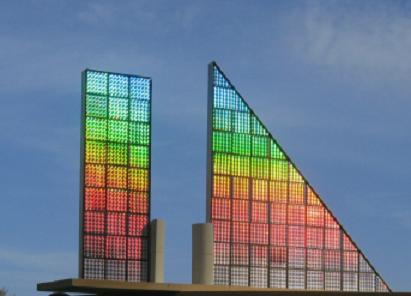
"Inspired by the work of Dale Eldred, Thomas Lindsey draws on his background as an architect and sculptor to develop a series of large solar-powered installations. Each of these installations is made of a kinetic wheel, cone, or drum activated by a set of photovoltaic solar cells. A tracking device will be used to direct the cells at the sun's path. By using solar energy as a power source, Lindsey hopes to encourage the use of environment-friendly energy sources as the issue of global warming becomes more urgent. Lindsey also plans to include musical compositions as elements in his constructions.
Utilizing the idea of a Buddhist prayer wheel, Lindsey's work is ultimately intended to serve as a contemporary shrine or meditation garden. Through his art, Lindsey aims to promote a greater awareness and appreciation of the biospiritual Earth-Sun relationship"
SOLER POWAAAA
Researching Solar Energy is a very important issue that has reached the world. Some countries, earlier than others have been using this solar energy for years before America, but finally we have joined in and are working to get more solar energy out to the public. Starting with farmers and their need for solar energy to help with energy costs and share with small towns surrounding them for a price, and to big businesses and factories where solar energy would stop coal powered and nuclear powered plants in return for a healthier ans safer alternative that helps the environment and saves on their energy cost bills. I found that our school is also involved in creating solar energy and making a solar car! There link explains why they're making it, how it was made and about what this solar car has done since its creation.
http://www.newpaltz.edu/solarcar/minie.html
I have also been wondering HOW solar energy works and how things such as solar panels are made. When I studied abroad in Denmark, I often took the train past farms and factories that used solar energy but also wind energy that would be very beneficial for some area of America such as Illinois and solar energy is very beneficial for areas such as Arizona or Nevada. I found a youtube video that shows how solar panels are made and I thought you might also be interested in how things work underneath this amazing discovery and invention!
http://www.newpaltz.edu/solarcar/minie.html
I have also been wondering HOW solar energy works and how things such as solar panels are made. When I studied abroad in Denmark, I often took the train past farms and factories that used solar energy but also wind energy that would be very beneficial for some area of America such as Illinois and solar energy is very beneficial for areas such as Arizona or Nevada. I found a youtube video that shows how solar panels are made and I thought you might also be interested in how things work underneath this amazing discovery and invention!
Thursday, February 11, 2010
I thought I'd also show a remix to the advertisement for the famous SlapChop. A DJ did the remix and SlapChop actually has used the remix as an advertisement and I personally find it much more interesting with the remix and makes me want to buy it more because it seems to talk to the younger viewer and I have more respect for the company because they feel comfortable making fun of themselves.
Thursday, February 4, 2010
technology, technology, technology everywhere!
So I have had this conversation with many friends and I've come to the conclusion that technology is everywhere. Listening to music by Bow Wow has references such as "I'm checking smiley faces in my sidekick" referring to a phone. There are songs that specifically refer to only certain types of electronics that can soon be outdated such as "Friend Request" by Gym Class Heroes and "Send Me An E-mail" by T-Pain featuring Tila Tequila. The fact that there are songs that use technology in the title and have it as the subject of the song makes me wonder whether we could ever go back to the song "Knock Three Times" which sings about using a ceiling as a form of communication. Should it be "Text Me Sometime"? Tweet has a song from the early 2000's where she sings "Call Me". But even that is outdated. No one calls anymore unless its necessary. People communicate mostly through text message, I've even heard of people breaking up over text messages. The movie "You've Got Mail" no longer qualifies as valid, because people don't use e-mail unless its for business. Facebook is the best way to communicate with someone if text messages don't work. To hear that someone doesn't have a cell phone is unspeakable and to not have a computer would seriously damage someone's communication with the outside world. I hear of people not having a television and I can't understand how they hear about the news. Then I remember that I don't watch television to hear about news either. I have it text messaged to my phone from twitter. I update my facebook through twitter. And that's when it hit me, I am as caught up in technology as anyone else. And it seems to be so convenient for me. But how difficult was it before? To sit down with the family at 6 o'clock and watch eyewitness news. To talk on the phone to someone or speak in person, to hear someone's voice and see their face. Sure we have skype now, but I can't touch the person. It feels like they're sitting across from me, but the technology has gotten so good that I can actually fool myself into thinking that I've seen that person in real life. I'm sure this is a ramble but my point is, when is something too much? When will things get too advanced that even a young person can't keep up with it? When will technology become so impersonal that real interactions don't exist anymore? How long will it take?
Sunday, January 31, 2010
The Language of New Media Prologue
Reading Lev Manovich's The Language of New Media Prologue, one learned alot about the purpose and meaning behind the movie. Manovich emphasizes key points to the reader in order to explain the concept of the Man With A Video Camera.
Incorporations of camera controls marks a historic moment in video. Manovich explains "Directing the virtual camera becomes as important as controlling the hero's actions" when filming something. The incorporation of the camera is important to the context of the video because otherwise, there would be a loss of solid foundation in the movie. Editing and Montaging was also important to the making of this video. The montaging created false realities that built a story out of a collection of different stories. Broken pieces were collected to become one image. Zoom was critical in the movie. Utilitizing the zoom allowed for concentration. The cameraman is compared "to a surgeon" who uses the zoom to allow for the best performance. Modernization also adds to the complexity of Man With A Video Camera. Adding limitations of physical space, it forces the viewer to acknowledge the intention of the actions. The relations between the objects creates another story in itself for each scene. Vision and perspective have an influence on the viewers outlook on the movie. The perspective and view constantly changes in the video confusing the viewer. The question is always who is the view the camera is depicting, whether it be computer, a person, or different people and different narrators is never answered.
The levels of viewing are split into three different layers. The first, is the cameraman's view from behind the camera, and what he can see that the viewer cannot. The second being the viewer and the audience's. What the camera portrays is what the viewer sees, but with the use of editing and montaging, what the audience sees is not always what is really there. Lastly, the film itself is a level of viewing. What the film records is different to what the other two levels may see and because of the many different locations that the video takes place in also changes how the film records what is captured. The director, Dziga Vertov never resolves to a certain type of cohesive language in a way or portrayal speaking. The film is untamed and the "effects" and techniques are endless, allowing for chaos in the video. Turning the "effects" into artistic language was possible through the lack of constant view. He then used the term "kino-eye" to describe skewed views that allowed for an artistic perspective. Manovich then explains that the camera becomes part of the cinema's apparatus. The camera decides what we see and how it is filmed allowing for it to be the main narrator. Manovich also says that Vertov overcomes the limits of human vision and coins the term "kino-eye" mentioned earlier which means he uses "new techniques of obtaining images and manipulating them", which he says can be used to decode the world.
Incorporations of camera controls marks a historic moment in video. Manovich explains "Directing the virtual camera becomes as important as controlling the hero's actions" when filming something. The incorporation of the camera is important to the context of the video because otherwise, there would be a loss of solid foundation in the movie. Editing and Montaging was also important to the making of this video. The montaging created false realities that built a story out of a collection of different stories. Broken pieces were collected to become one image. Zoom was critical in the movie. Utilitizing the zoom allowed for concentration. The cameraman is compared "to a surgeon" who uses the zoom to allow for the best performance. Modernization also adds to the complexity of Man With A Video Camera. Adding limitations of physical space, it forces the viewer to acknowledge the intention of the actions. The relations between the objects creates another story in itself for each scene. Vision and perspective have an influence on the viewers outlook on the movie. The perspective and view constantly changes in the video confusing the viewer. The question is always who is the view the camera is depicting, whether it be computer, a person, or different people and different narrators is never answered.
The levels of viewing are split into three different layers. The first, is the cameraman's view from behind the camera, and what he can see that the viewer cannot. The second being the viewer and the audience's. What the camera portrays is what the viewer sees, but with the use of editing and montaging, what the audience sees is not always what is really there. Lastly, the film itself is a level of viewing. What the film records is different to what the other two levels may see and because of the many different locations that the video takes place in also changes how the film records what is captured. The director, Dziga Vertov never resolves to a certain type of cohesive language in a way or portrayal speaking. The film is untamed and the "effects" and techniques are endless, allowing for chaos in the video. Turning the "effects" into artistic language was possible through the lack of constant view. He then used the term "kino-eye" to describe skewed views that allowed for an artistic perspective. Manovich then explains that the camera becomes part of the cinema's apparatus. The camera decides what we see and how it is filmed allowing for it to be the main narrator. Manovich also says that Vertov overcomes the limits of human vision and coins the term "kino-eye" mentioned earlier which means he uses "new techniques of obtaining images and manipulating them", which he says can be used to decode the world.
Saturday, January 30, 2010
Well That Was Different
The experimentation with different types of story telling in There is No End To More was more than varying. In the beginning when we watch an interpretive dance along with a whispered narrative that confused me as to whether I should look at him or listen. So I did both, and then each one separately. When he said "my ears are stars", I began to wonder where this was going and for how long it would last.
There was then what seemed to be a talk show, but there were no contestants and the host is a man pretending to be a child. He then has conversations with pre-recorded voices played on speakers around the theater. Flashes of old and new popular imagery in the background and sounds of barking and howling, followed by animated characters who are eaten by another cartoon. Ending in a 3 minute dialogue about a little girl shrinking that ended with "my mom's gonna kill me when I get home" was enough to wrap up the hour long performance that was too long.
The show was beyond confusing and very odd but I will commend him on the use of technology in the presentation. He used audio and visual and touched your senses with both. Flashing lights for the images and then colors later on when he began to interpretively dance again brought things to your attention. The loud sounds on the audio and the immature jokes he used entertained but also made you listen. The use of technology worked for his advantage on this tumultuous show.
There was then what seemed to be a talk show, but there were no contestants and the host is a man pretending to be a child. He then has conversations with pre-recorded voices played on speakers around the theater. Flashes of old and new popular imagery in the background and sounds of barking and howling, followed by animated characters who are eaten by another cartoon. Ending in a 3 minute dialogue about a little girl shrinking that ended with "my mom's gonna kill me when I get home" was enough to wrap up the hour long performance that was too long.
The show was beyond confusing and very odd but I will commend him on the use of technology in the presentation. He used audio and visual and touched your senses with both. Flashing lights for the images and then colors later on when he began to interpretively dance again brought things to your attention. The loud sounds on the audio and the immature jokes he used entertained but also made you listen. The use of technology worked for his advantage on this tumultuous show.
Tuesday, January 26, 2010
class
Today, I was in a class where the teacher explained to us that he had not printed out syllabuses because the English department had decided to go Eco-friendly and post everything on blackboard. To then please the people that needed to SEE the syllabus while he read it aloud (I being part of that group), then opened this nifty projector that showed us what was on his computer. He also, while taking attendance, printed out the wrong attendance sheet. So he had to go online and look at the attendance list in front of all of us, because he did not know how to keep that off the projector. I find it funny that this technology has progressed so far, and yet people who are forced to use it, often do not know how to use it properly. Should there be classes for this type of development in the classrooms? Should we let them learn how most people my age learn, by experimenting and trying new things that also include mistakes? Its a tough situation and you have to think of what is the solution for this, if there is.
Monday, January 25, 2010
Hey! So I guess I should introduce myself and whatnot. My name is Holly Gooden, I'm a Sculpture Major Senior (although I have 2 more semesters left) and I'm from Queens. Now that thats out of the way, I thought I'd post a video from youtube I saw recently that I thought was a great example of how technology has advanced and not only influenced music videos but is referenced in them also. This is Video Phone by Beyonce and it features Lady GaGa. Although I did enjoy the video, I have posted it for an academic reason, that being the reference to the large amount of technology and the abilities of digital technology in the beginning of the year 2010.
Subscribe to:
Posts (Atom)
